Designer Dog Furniture for Home Decor: 2026 Guide
Table of Contents
- Why Designer Dog Furniture Belongs in Your Home
- Luxury Dog Crate End Tables That Double as Decor
- How to Style a Dog Crate in Any Room
- Pet-Friendly Interior Design Tips for Cohesive Spaces
- Materials and Craftsmanship: What Sets Designer Dog Furniture Apart
- Pet Ergonomics and Safety Certifications
- DIY vs. Custom vs. Retail: Choosing Your Approach
- Conclusion: Elevate Your Home with Designer Dog Furniture
- Frequently Asked Questions
Last Updated: September 19, 2026
Why Designer Dog Furniture Belongs in Your Home
Designer dog furniture for home decor is pet furniture built to the same standard as the pieces you would buy for yourself: furniture-grade wood, premium upholstery, and finishes that match your interior rather than fight it. At Dogominium, we build architecturally inspired dwellings because a crate should not be the one object in the room you apologize for.
The shift is practical, not just visual. A standard wire crate occupies floor space and returns nothing. A furniture crate holds a lamp, a stack of books, a cup of coffee. It performs two jobs in one footprint, which matters in smaller homes where every square meter is spoken for.
Below, we break down how to choose, style, and maintain these pieces so they look intentional in every room.
Luxury Dog Crate End Tables That Double as Decor
A luxury dog crate end table is a crate engineered to function as a side table first and a kennel second. The top surface is structural, not decorative, and the interior is sized for a dog to stand, turn, and lie down without restriction.
That dual purpose is the whole point. You are not buying a crate and hiding it behind a sofa. You are buying a piece that earns its place in the room.
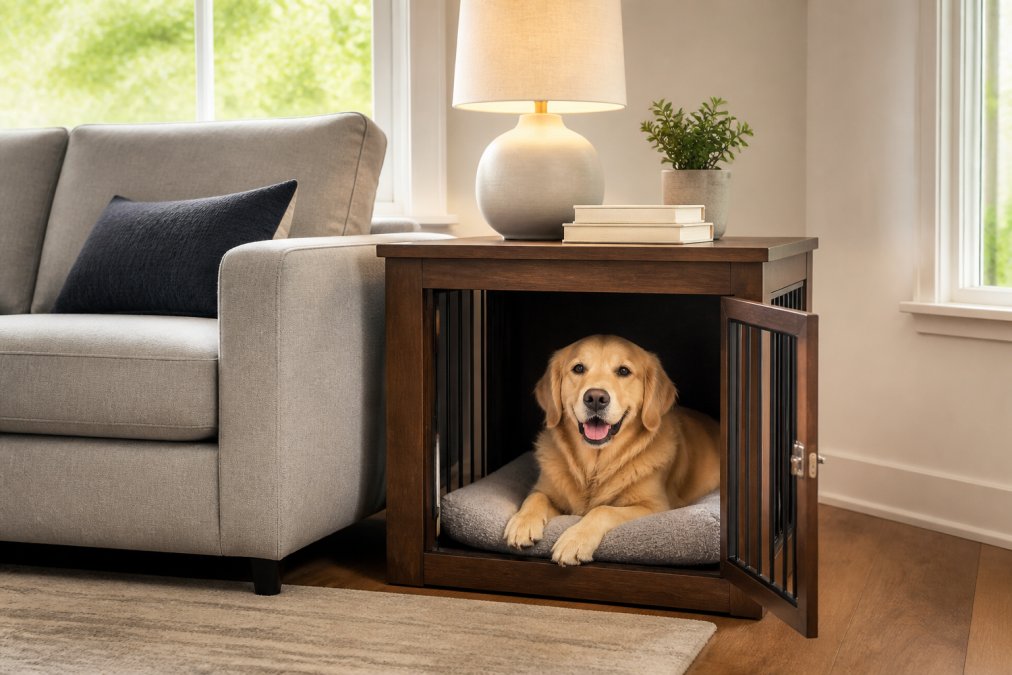
The Dogominium Fresco Luxury Side Table Crate is the clearest example of the category. It uses furniture-grade wood construction with designer wire mesh and stainless steel hardware, so the finish holds up to daily use without rusting or discoloring. The Lunar grey cabinetry finish sits comfortably against modern, minimalist, and mid-century interiors.

Two details separate a real end table crate from a crate with a board on top. First, the top must carry weight without flexing. Second, the doors must open without increasing the footprint. The Fresco solves the second with a two-door layout, front and side, which lets you place it against a wall or in a corner without blocking entry.
How to Style a Dog Crate in Any Room
Styling a dog crate comes down to three decisions: what sits on top, what surrounds it, and how the material relates to your existing finishes. Get those right and the piece reads as furniture.
Living Room Integration
In a living room, treat the crate as you would any side table. A lamp, a small tray, and one or two books is enough. Resist the urge to fill the surface; empty space is what makes a piece look considered rather than cluttered.
Position it at the end of a sofa or beside an armchair, aligned with the back of the seating. Alignment is what makes furniture look placed rather than parked.
Bedroom and Office Placement
In a bedroom, a crate works as a nightstand if the height matches the bed. In a home office, it functions as a low console beside a desk. Both placements benefit from the same rule: keep the top surface light and let the piece's lines do the work.
For larger breeds, a hutch-style piece with a sliding door is the better choice in tight rooms. The Dogominium Grand Haven uses a sliding barn-door system that glides open without adding to the footprint, which matters in hallways and open-plan layouts where a swinging door would interrupt the flow.

Pet-Friendly Interior Design Tips for Cohesive Spaces
Pet-friendly interior design tips usually stop at "choose washable fabrics." That advice is fine but incomplete. The pieces that survive a decade in a real home are the ones where the material choices were made for the dog first and the room second, and where the ergonomics of the dog using the piece were treated as a design constraint, not an afterthought.
Start with the surface the dog actually touches. Start with the surface the dog actually touches. Look for a removable, machine-washable cover, a mat that cannot go in the wash becomes a permanent odor source no matter how good the foam is.
Moderno Contemporary Luxury Dog Crate →
Then work outward to the finishes. Four rules that hold up under real use:
- Match the wood tone to your existing furniture, not to a trend palette, so the piece still reads as intentional after the trend passes
- Choose washable covers over fixed upholstery so cleaning does not mean replacing
- Avoid untreated surfaces; non-toxic, lead-free finishes protect both the wood and the dog that licks it
- Keep the silhouette simple so the piece sits alongside your decor instead of competing with it
Breathable fabric matters more than most buyers expect, especially in humid climates. A crate with solid panels and no airflow traps heat and odor; a crate with mesh or slatted sides lets air move through, which keeps the interior drier and the dog cooler. That is an ergonomic decision as much as an aesthetic one.
Finally, plan for the dog's size to change. Puppies grow into their adult dimensions within a year, and a crate sized for a puppy becomes a cramped crate for an adult. Measure your dog's adult expected height and length, not their current size, and leave enough interior room to stand without lowering the head, turn around, and lie fully extended. A crate that fits exactly is a crate that fits badly.
The health of the dog using the piece is the part of pet-friendly design that most guides skip entirely.
Materials and Craftsmanship: What Sets Designer Dog Furniture Apart
A simple maintenance rhythm keeps all of this manageable: wipe surfaces weekly, vacuum or brush fabric monthly, and inspect hardware and seams quarterly for looseness or rust.
Care is simpler than most people assume once the materials are matched to the right routine. That routine is what keeps the piece looking intentional for the life of the dog, not just the life of the trend.
Pet Ergonomics and Safety Certifications
Ergonomic support is the most under-covered topic in this category. A crate that looks beautiful but forces a dog to crouch or lie on a hard floor is a design failure, however good it looks in photographs.
On safety, ask three questions before buying:
- Are the finishes non-toxic and free of lead and heavy metals?
- Is the hardware rated for load, or is it decorative?
- Are there gaps or pinch points a paw or collar could catch on?
DIY vs. Custom vs. Retail: Choosing Your Approach
The three routes differ less in cost than in what you are actually buying: time, fit, or finish.
| Approach | What You Get | Best For | Main Trade-Off |
|---|---|---|---|
| DIY | Custom dimensions, your materials | Confident woodworkers with specific space constraints | Finish quality and hardware durability depend entirely on you |
| Custom | Built to your dimensions and finish | Odd room shapes, built-in placements | Lead times and higher cost |
| Retail | Proven construction, warranty, resale value | Most buyers who want it right the first time | Limited size and finish options |
Conclusion: Elevate Your Home with Designer Dog Furniture
The hard part is not finding beautiful pet furniture. It is finding a piece that still looks right in three years, fits your dog properly, and does not force you to choose between your interior and your dog's comfort.
Frequently Asked Questions
How do I choose designer dog furniture that matches my home decor?
Start by identifying your home's dominant style, such as mid-century modern, Scandinavian, or farmhouse. Look for pieces with complementary materials and finishes. For example, the Moderno Contemporary Luxury Dog Crate ($449.99) features a premium cabinetry finish and stainless-steel accents that suit modern interiors. Measure your space to ensure the piece fits without overwhelming the room, and consider multi-functional items like end tables that serve both your dog and your decor.
Are designer dog crates worth the investment?
Yes, for many owners. Designer dog crates are built with furniture-grade materials like solid wood and stainless steel, offering durability that mass-market plastic or wire crates lack. They also double as functional furniture, such as side tables or console pieces, so you're not sacrificing floor space. The Fresco Luxury Side Table Crate ($449.99) is an example that integrates seamlessly into living areas. Over time, the craftsmanship and aesthetic cohesion often justify the higher upfront cost.
What materials are best for luxury pet furniture?
Furniture-grade wood, stainless steel hardware, and non-toxic finishes are top choices. Solid reclaimed oak, as seen in the Grand Haven Furniture-Style Dog Crate ($8,999.00), provides structural integrity and a high-end look. Stainless steel resists rust and stands up to daily use. For outdoor pieces, weather-resistant materials like those in the Mid-Century Modern Dog House ($5,225.99) ensure year-round durability. Avoid particle board and untreated metals that can degrade or harm pets.
How can I hide a dog crate in my living room?
Choose a crate that functions as furniture, such as an end table or sideboard, so it blends with your existing decor. The Fresco Luxury Side Table Crate has a dual-door design and a neutral Lunar grey finish that works as an end-of-bed or sofa-side accent. Place it near other furniture to create a cohesive vignette, and top it with a lamp, books, or a plant. This way, the crate becomes an intentional design element rather than an eyesore.