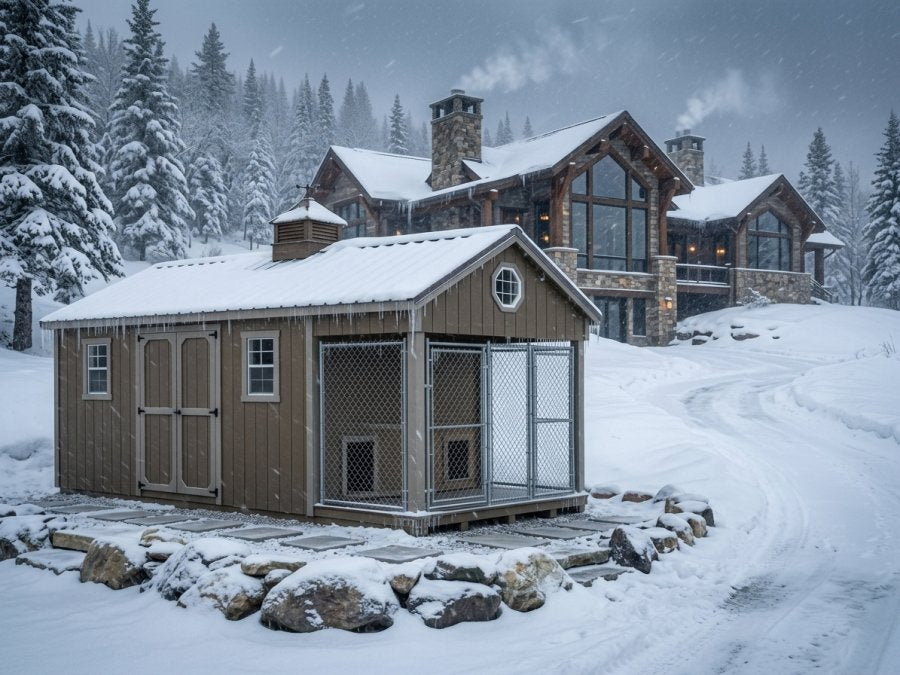
Best Insulated Dog Houses for Winter: 2026 Buyer's Guide
Table of Contents
- Quick Comparison: Best Insulated Dog Houses for Winter
- What to Look For in a Cold-Weather Shelter
- How to Winterize a Dog House
- Heated Dog House Pads and Safe Heating Elements
- Best Bedding for Outdoor Dog Houses
- Sizing, Breed-Specific Thermal Needs, and Kennel Integration
- Maintenance, Energy Efficiency, and Long-Term Costs
- Frequently Asked Questions
Last Updated: September 21, 2026
Quick Comparison: Best Insulated Dog Houses for Winter
The best insulated dog houses for winter hold warmth through double-walled construction, an elevated floor, and an R-value suited to your climate. Dogominium builds its Executive Estate line around those principles, with R-11 or R-13 insulation, spray foam floor protection, and optional climate control.

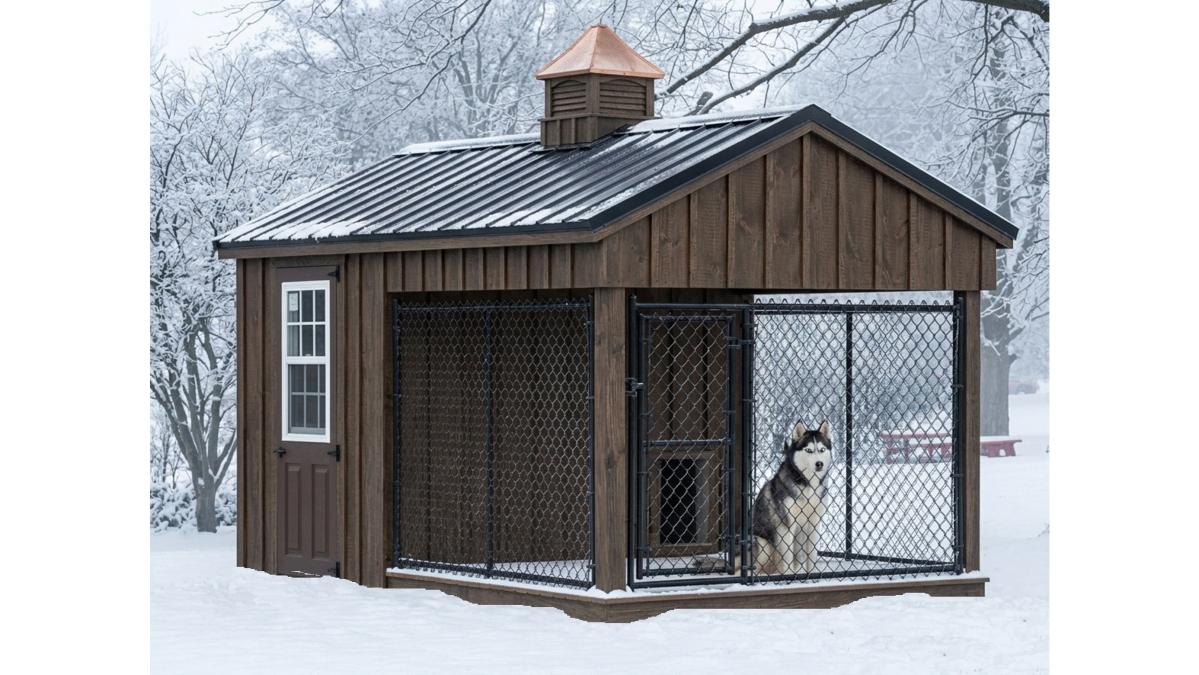
Model |
Size |
Starting Price |
Insulation |
Best For |
|---|---|---|---|---|
Executive Luxury Insulated Customized Dog Kennel |
4' x 8' |
$6,584.99 |
R-11 or R-13 |
Single medium to large dog |
Executive Estate |
6' x 8' |
$9,124.99 |
R-11 or R-13 |
One large dog, compact yard |
Executive Estate |
6' x 10' |
$10,484.99 |
R-13 or R-11 |
Large dog with run space |
Executive Estate |
8' x 10' |
$12,314.99 |
R-13 or R-11 |
X-large and giant breeds |
Executive Estate |
8' x 12' |
$14,782.99 |
R-13 or R-11 |
Giant breeds, extra room |
Executive Estate Single Run |
8' x 14' |
$14,879.99 |
R-13 or R-11 |
Giant breeds, long run |
Executive Double Kennel |
8' x 14' |
$17,656.99 |
R-13 or R-11 |
Two dogs, separate suites |
Double Kennel With Storage |
8' x 16' |
$19,683.99 |
R-13 or R-11 |
Two dogs plus feed storage |
Kennel With Storage Room |
8' x 18' |
$22,315.99 |
R-13 or R-11 |
Multi-dog plus storage |
Kennel With Storage Room |
8' x 20' |
$20,395.99 |
R-13 or R-11 |
Multi-dog, largest footprint |
What to Look For in a Cold-Weather Shelter
Four features decide whether a dog house works in January: insulation value, an elevated and insulated floor, draft-free assembly, and controlled ventilation. Skip one and the others lose much of their effect.

Insulation R-Value and Materials
Insulation R-value is a measure of how well a material resists heat flow; higher numbers mean slower heat loss. For dog houses in cold climates, R-11 to R-13 is a practical target, matching what Dogominium uses across its Executive Estate models. Foam insulation performs better than fiberglass batts in this setting because it seals gaps and resists moisture, which is why spray foam floor insulation appears in premium builds.

Elevated Floor, Draft-Free Construction, and Ventilation
An elevated floor keeps the dog off cold ground and blocks ground moisture from wicking upward. Double-walled construction with sealed seams stops drafts. Ventilation sounds contradictory in a winter shelter, but a sealed box traps humidity from the dog's breath, and damp air chills faster than dry air; gable vents and thermostatically controlled exhaust fans solve this without dumping heat.
How to Winterize a Dog House
Winterizing a dog house means sealing drafts, adding floor insulation, raising the structure off the ground, and refreshing bedding before the first hard freeze. It takes one afternoon.
- Inspect and seal. Check every seam, corner, and door frame. Caulk or foam any gap wider than a credit card.
- Insulate the floor. Add a foam board or spray foam layer under the floor deck. This is the single highest-impact upgrade.
- Elevate the structure. Set the house on blocks or a platform so the floor sits above snow and standing water.
- Face the door away from prevailing wind. A simple 90-degree turn can cut wind chill dramatically.
- Add a door flap. A heavy vinyl or plexiglass flap holds heat while still letting the dog come and go.
- Refresh bedding. Replace damp or flattened bedding with dry, insulating material.
- Check the roof. Confirm shingles are intact and the overhang sheds snow away from the entry.
Heated Dog House Pads and Safe Heating Elements
Heated dog house pads are the lowest-risk way to add warmth to an existing shelter. They run at low wattage and use thermostatically controlled elements that only draw power when the pad drops below a set temperature.
Best Bedding for Outdoor Dog Houses
The best bedding for outdoor dog houses is moisture-resistant, lofted, and machine-washable, because damp bedding is the most common reason an outdoor dog stays cold despite good insulation.
- Cedar or fir shavings: excellent insulation and odor control, but must be kept dry and replaced regularly.
- Straw: cheap and effective, though it compacts and needs frequent topping up.
- Fleece-lined orthopedic beds: comfortable and washable, best paired with a raised cot to keep them off the floor.
- Self-warming pads: reflect body heat without electricity, a good fit for milder winters.
- Heated pads: the strongest option for extreme cold, used with the safety rules above.
Sizing, Breed-Specific Thermal Needs, and Kennel Integration
Sizing a dog house is a balance: big enough to lie down, stand, and turn around, small enough that the dog's body heat helps warm the space. Too large is a common mistake and a reason a well-insulated shelter still feels cold. As a rule of thumb, the interior footprint should be about 1.5 times the dog's length from nose to tail base, and the ceiling should clear the dog's head by 3 to 6 inches.
Dog Type |
Recommended Size |
Heat Priority |
Notes |
|---|---|---|---|
Small or short-coated (Chihuahua, Dachshund, Greyhound) |
4' x 8' |
High, use a heated pad |
Low body fat loses heat fast |
Medium, single-coated (Labrador, Boxer, Pit Bull) |
6' x 8' |
Moderate to high |
Insulated floor is essential |
Large, double-coated (Husky, Malamute, Shepherd) |
6' x 10' |
Moderate, prioritize ventilation |
Overheats in sealed heated boxes |
Giant breed (Great Dane, Mastiff, Saint Bernard) |
8' x 10' or larger |
Moderate, maximize floor space |
Body heat warms the space |
Two dogs |
8' x 14' double |
Moderate, separate suites |
Prevents one dog from blocking the other's heat |
Senior or arthritic dog |
One size up from breed norm |
High, use a heated pad |
Joints stiffen in cold; add orthopedic bedding |
Retrofitting an Existing Kennel or Dog House
Most owners already have a structure, and replacing it is not always practical. Retrofitting works if you address the same four features a new build gets right: insulation, floor, drafts, and ventilation.
Executive Luxury Insulated Customized →
- Add rigid foam board to the walls and ceiling. One-inch polyiso or extruded polystyrene (XPS) adds roughly R-5 to R-6 per inch and can be cut to fit between studs or glued to interior surfaces. Face the foil side inward in cold climates.
- Insulate the floor from below. Foam board fastened under the deck, or a spray foam layer, stops ground cold from wicking up. This is the highest-impact single upgrade.
- Seal drafts with caulk and foam. Gaps wider than a credit card let heat escape. Pay attention to the door frame and any seams where panels meet.
- Add a door flap. A heavy vinyl or plexiglass flap holds heat while still letting the dog come and go.
- Keep a vent near the top. A sealed box traps humidity from the dog's breath, and damp air chills faster than dry air.
Maintenance, Energy Efficiency, and Long-Term Costs
Maintenance and energy use are where cheap dog houses quietly cost more than they save. A house that needs re-caulking every fall, rots at the floor, or runs a heater at full power all winter will outspend a well-built shelter over its lifetime. No competitor publishes cost-to-run numbers, so here is how to estimate them yourself.
Estimating Cost-to-Run for a Heated House
Watts ÷ 1,000 × hours of actual runtime × your electricity rate = cost per day
What Drives Efficiency
Energy efficiency comes down to three things: insulation value, air sealing, and how often the heat source runs.
- Insulation value. R-11 to R-13 walls and an insulated floor slow heat loss, so the heater cycles less. Foam insulation outperforms fiberglass batts here because it seals gaps and resists moisture.
- Air sealing. Gaps around doors and seams let heat escape no matter how thick the walls are. Caulk and foam are cheap; the savings compound.
- Runtime control. A thermostatically controlled system cycles on only when needed, while a constantly running heater wastes power. Low-temperature HVAC units hold efficiency better than standard units in freezing conditions.
Maintenance Schedule
Maintenance is short but regular. Put it on a calendar so nothing gets skipped.
- Monthly: Inspect heated pads and cords for chew damage, fraying, or wear. Wipe down the interior and check bedding for dampness.
- Each fall: Check the roof and shingles. Re-seal any cracked caulk. Clear vents of debris. Confirm the door flap still hangs straight.
- Each spring: Rinse and dry the interior. Touch up any finish wear. Check the floor for soft spots or rot.
Frequently Asked Questions
How cold is too cold for a dog outside in a dog house?
Most veterinarians consider temperatures below 32°F risky for small, thin-coated, or senior dogs, while larger double-coated breeds tolerate colder conditions longer. An insulated dog house with R-11 or R-13 walls, an elevated floor, and draft-free construction can hold interior temperatures noticeably above outside air, but it is not a substitute for supervision. In sustained sub-zero wind chill, bring your dog indoors regardless of shelter quality.
How much warmer is an insulated dog house than a non-insulated one?
The difference depends on insulation R-value, floor construction, and how well the structure blocks drafts. A house built with R-11 or R-13 insulation, spray foam floor protection, and a small, correctly sized entry can retain body heat far better than thin single-panel construction. A properly sized dog house also matters: a house that is too large for your dog lets body heat escape into unused space.
What is the warmest thing to put in a dog house in winter?
The best bedding for outdoor dog houses combines insulation from the ground with moisture resistance. Cedar shavings, thick orthopedic beds with removable waterproof covers, and self-warming or heated dog house pads all work well. Avoid blankets that absorb moisture and freeze. Pair bedding with an elevated floor and a draft-free door so warmth stays trapped inside the shelter.
Do dogs really need an insulated house in winter?
It depends on breed, coat, age, and climate. Short-haired breeds, puppies, seniors, and dogs in regions with sustained freezing temperatures benefit significantly from insulated shelter. Double-coated breeds like huskies and Great Pyrenees handle cold better, but they still need a dry, draft-free space out of wind and precipitation. An insulated dog house also helps in summer by slowing heat transfer.
How do I winterize a dog house before the first freeze?
Start by sealing gaps around the door and roof, then add or replace insulation if R-value is low. Raise the floor off the ground, add a wind-blocking flap or guillotine door, and layer moisture-resistant bedding. Check any heated dog house pads or heating elements for frayed cords, and confirm ventilation is clear so humidity does not build up. A quick inspection before the first freeze prevents most cold-weather problems.