

Why Choose Furniture Grade Dog Houses: 2026 Guide
Table of Contents
- Why Choose Furniture Grade Dog Houses Over Standard Builds
- Furniture-Grade Dog Houses vs Furniture-Style Crates: A Real Comparison
- The Best Material for an Outdoor Dog House: Ratings and Pricing
- Dog House Size Guide: Matching Interior Space to Your Dog
- Heated Dog House Pads for Winter: What Actually Keeps Dogs Warm
- Long-Term Cost, Repairability, and Chew Resistance
- Verdict: Who Should Buy Furniture Grade
- Frequently Asked Questions
Last Updated: October 9, 2026
Why Choose Furniture Grade Dog Houses Over Standard Builds
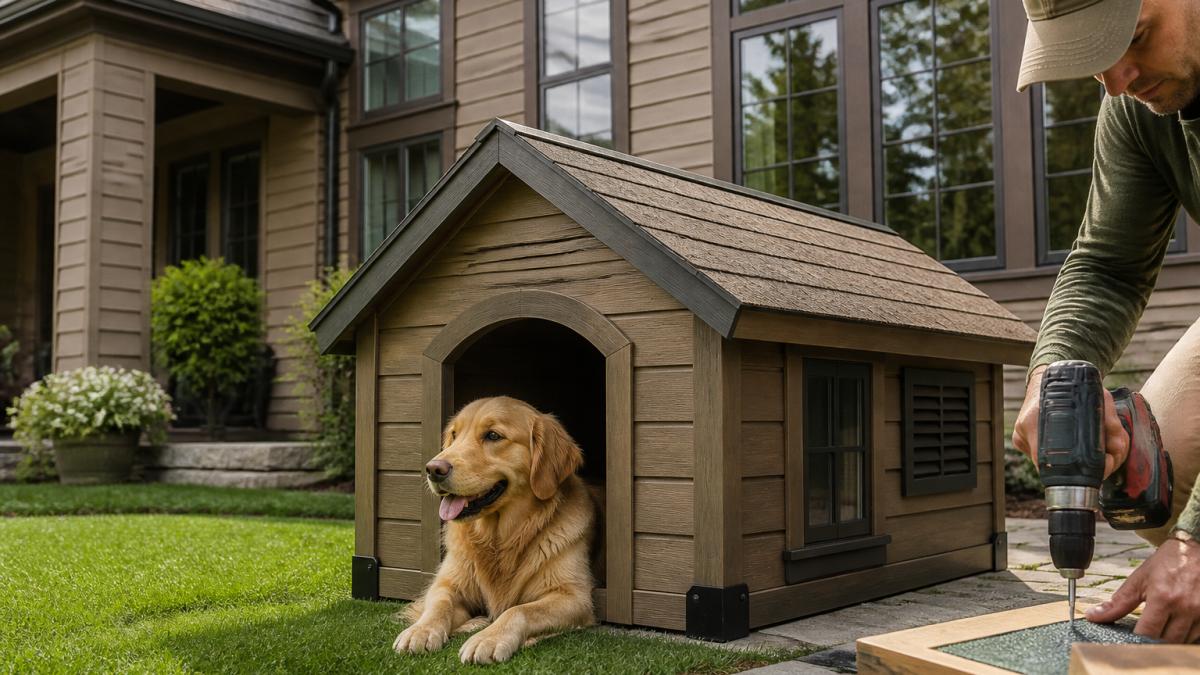
A furniture grade dog house uses the same materials, joinery, and weather detailing as the home beside it, not a thin-panel pet box. That is why furniture grade dog houses hold up for a decade or more while big-box kennels need replacing within a few seasons.
At Dogominium, we build every kennel to residential code standards, a gap that is not cosmetic.
A standard build saves money up front and costs it back later: thin walls sweat, plywood floors splinter, hardware rusts. Furniture grade construction flips that math with insulated walls, real roofing, and a hose-down interior.
The five differences that matter most:
- Materials: residential-grade siding, shingles, and insulation instead of consumer-grade panels
- Thermal control: R-11 or R-13 insulation versus passive ventilation only
- Flooring: polyurea coatings versus bare plywood
Furniture-Grade Dog Houses vs Furniture-Style Crates: A Real Comparison
These are two products solving two problems. A furniture-grade dog house is an outdoor structure engineered for weather and climate. A furniture-style crate is indoor furniture that doubles as a dog den.
The American Kennel Club's crate training guidance frames crates as short-term management tools, not permanent housing, which is exactly the line between these categories.
Here is the practical split:
- Furniture-grade dog house: outdoor placement, weather resistance, insulation, climate control, size options for large breeds
- Furniture-style crate: indoor placement, home décor integration, dual-purpose as an end table or nightstand, sized for medium dogs
Neither is better. They serve different rooms and different jobs.
Quick Comparison: Executive Estate Kennels and the Artisanal End Table Crate
| Product | Price | Placement | Best For | Size Range |
|---|---|---|---|---|
| Executive Estate 4' × 8' | $6,584.99 | Outdoor | Single large dog | Large |
| Executive Estate 6' × 8' | $9,124.99 | Outdoor | Large dog, extra room | Large |
| Executive Estate 6' × 10' | $10,484.99 | Outdoor | Multi-dog households | Large |
| Executive Estate 8' × 10' | $12,314.99 | Outdoor | Giant breeds | X-Large |
| Artisanal Wooden Kennel & End Table | $2,789.99 | Indoor | Medium dogs, 25-55 lb | Medium |
The Executive Estate line handles weather and climate; the Artisanal piece handles your living room. Pick based on where your dog spends the day.

The Best Material for an Outdoor Dog House: Ratings and Pricing
The best material for an outdoor dog house is a hardwood or steel frame paired with residential-grade siding, real shingles, and spray foam insulation. Wood alone is not enough. The assembly is what survives weather.
"Furniture grade" is a construction standard, not a marketing word. Here is how to tell a genuinely furniture-grade build from a furniture-style one.
What "Furniture Grade" Actually Means
Furniture grade describes how a piece is built, not just what it is made of. Four things separate it from a consumer-grade pet box:
- Wood species and stock thickness: kiln-dried hardwood or thick structural lumber rather than thin veneer-over-particleboard panels. Kiln drying matters because green lumber moves as it seasons, opening joints and letting water in.
- Joinery: mortise-and-tenon, lap, and dado joints distribute load across the wood. Butt joints held with screws and glue loosen, and once a joint opens, water follows.
- Hardware: stainless or powder-coated steel hinges, latches, and fasteners. Stamped hinges and zinc-plated screws rust first and fail first.
A quick field test: look at a corner joint. End grain butted against another board's face with a screw head showing means furniture-style; interlocking boards mean furniture grade.
Material Ratings for Outdoor Use
We rate materials on four factors: weather resistance, chew resistance, ease of cleaning, and repairability.
- Residential siding (L-P, board and batten, metal): best weather resistance, easy to match your home's exterior
- 30-year architectural shingles: the same roofing used on premium homes, rated for decades
- Polyurea flooring: impervious to moisture, resists rot and odor, rinses clean
What most guides miss is that the floor determines the lifespan. A plywood floor that stays wet will fail long before the walls do.
Why Polyurea Flooring and Trusscore Wallboard Change the Maintenance Equation
Polyurea flooring is a spray-applied coating that resists moisture, chemicals, and abrasion. Trusscore wallboard is a PVC panel system that does not absorb water or support mold. Together they make a dog house interior a surface you can rinse.
Compare that to plywood, which absorbs urine, swells at the seams, and delaminates within a season or two of heavy use. Replacing it means disassembling part of the structure.
Indoor Versus Outdoor Suitability
Attractive wood construction does not make a product weatherproof. A furniture-style crate finished for a living room will not survive a season outdoors, because its finish, joinery, and hardware were never specified for rain, freeze-thaw cycles, or UV exposure. Outdoor suitability requires:
- A roof with real overhangs and flashing, not a flat lid
- Raised flooring or a vapor barrier so ground moisture does not wick up
- Sealed exterior finish rated for exterior exposure
If a product is sold as indoor furniture, treat it as indoor furniture regardless of how solid the wood looks.
Dog House Size Guide: Matching Interior Space to Your Dog
The right interior space gives your dog room to stand, turn around, and lie down fully stretched, and no more.
Measure two things: your dog's length from nose to base of tail, and height from floor to shoulder.
| Dog Size | Weight Range | Minimum Interior | Recommended Kennel |
|---|---|---|---|
| Medium | 25-55 lb | 30" × 20" | Artisanal End Table Crate (indoor) |
| Large | 55-90 lb | 4' × 4' | Executive Estate 4' × 8' |
| Large, active | 70-100 lb | 5' × 6' | Executive Estate 6' × 8' |
| Multi-dog | varies | 6' × 8' | Executive Estate 6' × 10' |
| Giant breeds | 100+ lb | 7' × 8' | Executive Estate 8' × 10' |
For indoor crates, body shape matters as much as weight. Long-backed breeds like Corgis and Dachshunds need extra length; tall breeds like Boxers and Shepherds need extra height.
Executive Luxury Insulated Customized Dog Kennel - 4' × 8' →

Heated Dog House Pads for Winter: What Actually Keeps Dogs Warm
Heated dog house pads for winter help, but they are the last line of defense, not the first. Insulation and wind-blocking design keep a dog warm far more effectively than a pad alone.
A heated pad conducts warmth through contact, which only helps if the dog stays on it.
The layers that matter, in order:
- Insulation (R-11 or R-13): slows heat loss through walls and ceiling
- Spray foam under the floor: stops cold transfer from the ground
- Wind protection: plexiglass dog doors and guillotine doors block drafts
- Bedding: a cushion or orthopedic bed lifts the dog off the floor
- Heated pad: adds contact warmth on the coldest nights
For extreme cold, a wall-mounted heater or a low-temperature HVAC unit changes the equation entirely. The Executive Estate line supports both.
Long-Term Cost, Repairability, and Chew Resistance
Furniture grade costs more up front and less over time. The question is not whether a $6,000 kennel beats a $400 one, but what you spend across ten years of ownership.
Cheap kennels fail in predictable places: floors, hinges, roofs, and door latches. Each failure either ends the product's life or costs more to repair than the original purchase. Furniture grade construction is designed so those components can be serviced.
Where Cheap Kennels Fail, and What Repair Looks Like
- Floor: plywood delaminates and swells at seams after repeated wetting. In a cheap unit the floor is often structural, so replacing it means partial disassembly; in a furniture-grade unit it is a serviceable panel over a sealed substrate.
- Hinges and latches: stamped hinges bend and zinc-plated screws rust. Replacing them is cheap if the mounting holes are not stripped, which is why furniture-grade builds use through-bolted or reinforced mounting points.
- Roof: a flat or low-slope lid with no flashing leaks at the seams. A shingled roof with proper flashing can be patched like a house roof.
The practical test: can a component be removed and replaced without cutting into the structure? If yes, the product has a repair path. If no, the first major failure is the end of the product.
The Real Cost Comparison
Think cost per year of service, not sticker price. A kennel that lasts fifteen years costs less per year than a cheap one replaced every three years, and you only build it once, provided the furniture-grade unit is actually repairable.
Chew Resistance and Behavior Trade-Offs
Chew resistance comes down to materials. Powder-coated steel frames and reinforced latching handle moderate chewers well. No furniture-style product, indoor or outdoor, is recommended for dogs with severe destructive chewing habits or escape-driven behavior.
A beautiful wooden structure is not right for every dog:
- Chewing: a determined chewer can damage even hardwood. Steel framing and reinforced latches raise the threshold, but they are not a guarantee.
- Escape risk: a dog that has learned to work a latch will eventually defeat most residential-style hardware. If escape is a pattern, a purpose-built containment crate is the safer choice.
- Crate training: an enclosed furniture piece works well as a den for a dog already comfortable with crating. For a dog that is not crate trained, introduce it gradually rather than shutting the door on day one.
The ASPCA's guidance on cold weather safety for pets makes the point plainly: shelter quality, not shelter presence, determines whether an outdoor dog stays safe in extreme temperatures.
Verdict: Who Should Buy Furniture Grade
Furniture grade dog houses make sense for owners in extreme climates, owners of large or giant breeds, and anyone tired of replacing cheap kennels every few years.
If your dog lives indoors and you just need a crate that looks good in the living room, the Artisanal Luxury Wooden Dog Kennel & End Table is the better fit.
For outdoor use, we recommend the Executive Estate line.
If you want a structure tailored to your dog's measurements, your climate, and your home's exterior, a Custom Built Dog House lets you specify the size, materials, and features rather than adapting a stock model.
The U.S. Department of Energy's guidance on insulation ratings explains why R-value matters: it measures resistance to heat flow, and higher ratings mean slower temperature loss.
Frequently Asked Questions
What makes a dog house furniture grade?
Furniture grade means the structure is built to the same standards as residential furniture and housing, not consumer-grade pet products. That includes solid hardwood or reinforced framing, residential-grade siding and 30-year architectural shingles, R-11 or R-13 insulation, and finishes like polyurea flooring and Trusscore wallboard that resist moisture and odor. Joinery, hardware, and latching are rated for daily use rather than occasional backyard exposure, which is why furniture grade dog houses hold their appearance and structure far longer than thin-panel alternatives.
What is the best material for an outdoor dog house in extreme weather?
For year-round outdoor use, the best material for an outdoor dog house combines insulated wood-frame construction with weather-rated exterior finishes. Look for R-11 or R-13 insulation, spray foam under the floor to block ground cold, 30-year architectural shingles or a metal roof, and polyurea or composite flooring instead of bare plywood. The Executive Estate line uses these residential-grade materials and adds optional HVAC, so the interior stays stable whether your region swings between brutal winters and intense summers.
How do you choose the right size dog house using a dog house size guide?
Measure your dog from nose to the base of the tail, then add roughly 6 to 12 inches of extra length so they can turn around and stretch out. For height, your dog should be able to stand without ducking. A dog house size guide for large breeds typically points to footprints like 4' x 8', 6' x 8', 6' x 10', or 8' x 10'. Oversizing for cold climates is a mistake, since a smaller interior holds warmth better unless the kennel is climate controlled.
Are heated dog house pads for winter enough on their own?
Heated dog house pads for winter help, but they work best inside an insulated structure. A pad in an uninsulated house loses heat to the floor and walls, so your dog gets a warm spot rather than a warm room. Pair a pad with R-11 or R-13 insulation, spray foam flooring, and a wind-blocking door like plexiglass or a guillotine door. In colder regions, a built-in wall heater or a 12,000 BTU HVAC unit keeps the whole interior consistent instead of just one spot.
Choosing the right dog house comes down to one question: do you want to buy a shelter or an asset? A cheap kennel is a recurring expense. A furniture grade structure is a one-time investment that protects your dog every season. Dogominium builds architecturally inspired kennels with climate control, residential-grade materials, and customization that matches your home, and one percent of our profits goes to rescue shelters. Get started with Dogominium and give your dog a space built to last.


