

How to Choose Designer Pet Furniture for Your Home
Table of Contents
- Assess Your Home's Design Style and Space
- Evaluate Durable Pet Furniture Materials
- Designer Dog Kennels That Integrate Into Your Interior
- Selecting Designer Dog Beds for Comfort and Style
- Designer Dog Furniture for Home Decor Integration
- Prioritize Pet Safety, Health, and Functionality
- Size, Scale, and Placement Considerations
- Conclusion
- Frequently Asked Questions
Last Updated: October 7, 2026
Assess Your Home's Design Style and Space
Choosing designer pet furniture starts with understanding your home's aesthetic. Walk through and identify your style: modern, rustic, transitional, minimalist, or eclectic.
Consider the room where your pet spends the most time: a sleek metal crate works in a contemporary loft, a wooden kennel in a farmhouse. The goal is integration, not contrast.
Scale matters too: a large dog bed overwhelms a small apartment, a tiny crate looks lost in a sprawling living room.
Finally, think about functionality. Do you need something that doubles as a side table? A bed that's easy to clean? A crate that's portable? Your lifestyle and your dog's habits shape what works.
Evaluate Durable Pet Furniture Materials
The material you choose determines how long your investment lasts. Designer dog furniture built to last resists wear, staining, and odor.
Hardwood, oak, walnut, maple, handles scratching and impact better than softwoods and develops a patina over time.
Metal frames and hardware matter just as much.
Upholstery deserves attention: performance fabrics resist stains, moisture, and odors. Look for high rub counts and washable covers you can remove and clean yourself.
The best materials combine beauty with practicality: a wooden kennel with stainless steel hardware and a removable, washable cushion handles years of use while looking sophisticated.
Designer Dog Kennels That Integrate Into Your Interior
A well-designed kennel becomes part of your room's architecture, not a visible pet accessory. The Artisanal Luxury Wooden Dog Kennel & End Table from Dogominium demonstrates this: hand-built in Penrose, Colorado by a family-owned workshop, each piece is both a secure space for your dog and an elegant end table that anchors a seating area.

What makes a kennel designer-grade is how it handles multiple purposes. A crate that doubles as furniture saves space, and its architectural details, cutouts, finish, hardware, should feel intentional.
Placement matters: near a window gives natural light, a high-traffic area keeps your dog connected to family, and corners suit dogs that prefer a den-like feel. Against a wall, a kennel becomes a design anchor, not an obstacle.
The interior matters too. A quality cushion transforms a crate from a cage into a sanctuary, so choose kennels that include or accommodate premium bedding that's easy to clean and replace.
Dogominium offers customization options for kennels, so you can match your specific style and space requirements. If you're looking for a Custom Built Dog House that combines indoor elegance with outdoor durability, their collection includes options designed to seamlessly extend your home's aesthetic to exterior spaces.
Selecting Designer Dog Beds for Comfort and Style
A luxury dog bed serves two purposes: it keeps your dog comfortable and adds visual interest to your room. The Yugen Pet Lounger in White Oak shows how a bed can be both functional and beautiful.

Raised beds promote circulation, reduce pressure on joints, and keep your dog off cold floors.
Material quality impacts longevity. Premium cushioning maintains its shape, upholstery-grade fabrics resist pilling and fading, and wood frames should be solid and properly finished to handle humidity without warping.
The best designer dog beds match your home's color palette. Neutral tones, whites, grays, warm woods, blend seamlessly, while bold colors work if they echo existing design elements.
Consider your dog's size and sleeping style. A large breed needs substantial support, an older dog benefits from orthopedic cushioning, and a small dog may prefer raised sides for security.
Designer Dog Furniture for Home Decor Integration
The most successful designer pet furniture disappears into your home's design scheme.
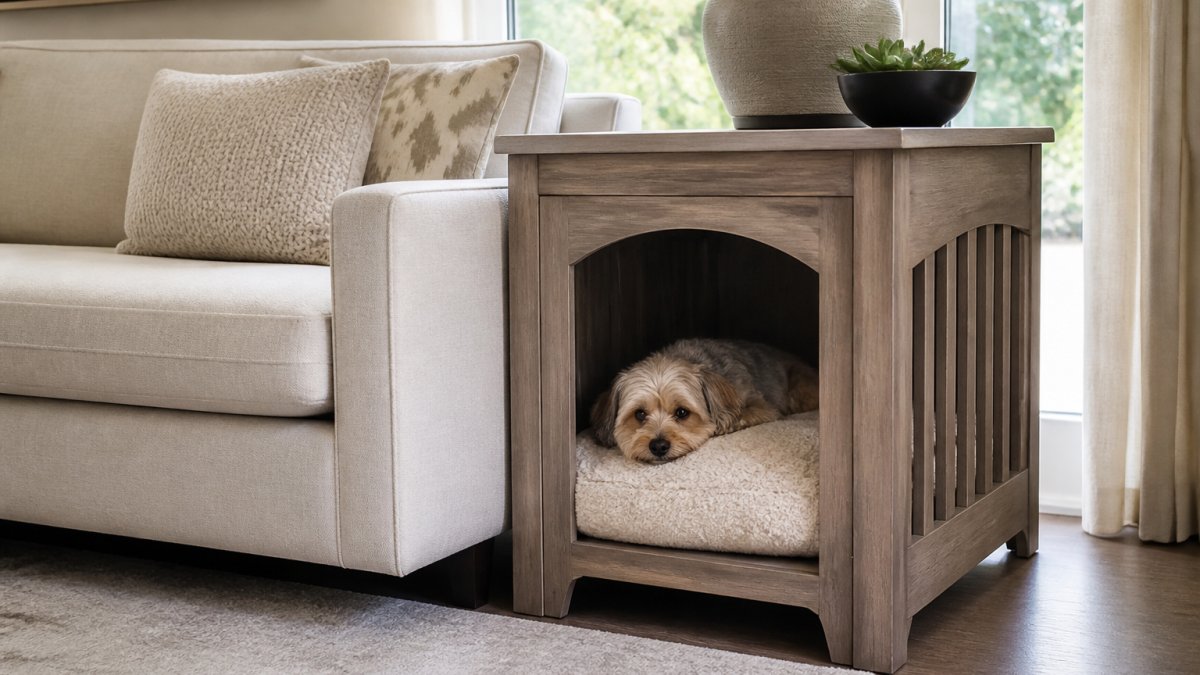
This requires intentional choices.
Hardware and accents matter enormously. Brushed metal looks modern. Ornate hardware feels traditional. Minimalist designs work everywhere. These small details either unify your space or create visual conflict.
Scale and proportion affect integration: a large crate dominates a small room but feels balanced in a spacious loft.
Grouping furniture intentionally creates cohesion. A designer bed near a matching kennel feels coordinated, while scattered pieces feel chaotic.
Color coordination ties everything together. Your dog's bed and crate don't need to match exactly, but they should work together.
Artisanal Luxury Wooden Dog Kennel & End Table →
Prioritize Pet Safety, Health, and Functionality
Designer dog furniture must prioritize your dog's wellbeing above all else. Beauty means nothing if the piece compromises your dog's health or safety, and this is the section most buying guides skip.
Ask what the finish actually is
"Pet-safe finish" is a marketing phrase, not a specification. Push for the chemistry. Common furniture finishes fall into a few buckets:
- Water-based polyurethane and water-based lacquer. Low odor, low volatile organic compound (VOC) content, and they cure hard enough for claw traffic. This is the finish most custom shops reach for when a buyer asks about pets.
- Oil-and-wax finishes (tung oil, linseed oil, hardwax oil). They penetrate rather than coat, so scratches can be spot-repaired instead of sanded out. The trade-off is that they need re-oiling periodically and some formulations contain solvents that off-gas for days.
- Conversion varnish and catalyzed lacquer. Extremely durable, common on production furniture, but higher in solvent content and best left to cure fully before a pet uses the piece.
- Solvent-based polyurethane. Hard and cheap, but the slowest to stop off-gassing and the least pleasant to live with in a small room.
Non-toxic materials: what to actually verify
- GREENGUARD Gold (administered by UL) tests finished products for VOC emissions and is the certification most often cited for indoor air quality. If a piece carries it, that is a meaningful signal about off-gassing.
- CARB Phase 2 / TSCA Title VI compliance applies to composite wood products (plywood, MDF, particleboard) and limits formaldehyde emissions. Solid hardwood sidesteps this entirely, which is one reason it commands a premium.
- OEKO-TEX Standard 100 applies to textiles and cushions. It screens for harmful substances in the fabric itself, which matters because your dog's nose and mouth are on that cushion for hours a day.
- Cradle to Cradle and FSC certification speak to material sourcing and recyclability rather than toxicity, but they are useful tiebreakers if two pieces are otherwise equal.
The chemicals worth naming
When you read a spec sheet, these are the terms to look for and, ideally, to see absent:
- Formaldehyde, common in adhesives and composite wood; a known respiratory irritant.
- Flame retardants (often listed as PBDEs or organohalogens), historically added to foam cushions; many buyers now specifically request foam without them.
- Phthalates, plasticizers sometimes found in vinyl or faux-leather trim.
- Azo dyes, used in some textiles; restricted under OEKO-TEX and EU rules, but not uniformly banned in U.S. furniture.
Ventilation, structure, and ergonomics
Ventilation prevents moisture buildup and respiratory issues. Solid-walled crates trap humidity and odors, so choose open-mesh or slatted designs, and raised beds that let air circulate underneath.
Structural integrity matters for safety. Hinges and latches should be secure, and bar spacing narrow enough that a paw or muzzle cannot get stuck, a common failure point on cheap crates. Test stability before purchasing.
Ergonomic design supports your dog's body. Orthopedic cushioning helps older dogs or those with joint issues, raised edges support the head and neck, and the right bed height makes entering and exiting easy for dogs with mobility challenges.
Cleaning without harsh chemistry
Easy cleaning prevents bacterial growth and odors, but the method matters as much as the material. Washable covers are non-negotiable, choose ones that survive a standard washer cycle, and use mild, pet-safe detergent over bleach-based cleaners that leave residue your dog will lick.
Size, Scale, and Placement Considerations
Getting the dimensions right determines whether your furniture works or becomes an expensive mistake. Measure your dog from nose to tail when stretched out. Add 4-6 inches for comfortable movement. This is your minimum bed length. Width should allow your dog to curl up or stretch sideways.
Crate sizing follows similar logic: your dog should stand, turn around, and lie down comfortably. Too much space encourages using a corner as a bathroom; too little feels confining. The right size is snug but comfortable.
Room dimensions and proportion
A large kennel dominates a small bedroom but feels proportional in a spacious living room. Measure your room and visualize placement before ordering, considering windows, doorways, and existing furniture.
Ceiling height affects perception. Tall, narrow pieces work under high ceilings; low, wide pieces suit standard or low ceilings, since a piece reaching toward the ceiling can make a room feel cramped.
Traffic flow determines placement. Your dog's furniture shouldn't block pathways; it should sit where your dog naturally wants to be, near windows for light, in social spaces to stay connected, or in quieter corners for retreat.
Multi-pet households: the logistics nobody writes about
Most guides assume one dog. If you have two or more, the design problem changes completely, and the failure modes are predictable.
Resource guarding is a design problem, not a training problem. Give each dog a piece with a clear sightline to the room but not to the other dog's piece.
Mixed sizes. A Great Dane and a Chihuahua cannot share furniture, and a piece sized for the Dane feels like a cavern to the Chihuahua.
Cats and dogs together. Cats want height; dogs want ground-level dens.
Placement for multi-pet flow
In a multi-pet home, placement is about sightlines and escape routes. Each pet's piece should have at least one unobstructed path out, so a pet never feels cornered, avoid dead-end corners with a single exit if another pet is pushy. In open-plan rooms, use the furniture to create soft zones: a kennel as an end table between two seating areas separates territories without walls.
Plan for change
Will you want to rearrange furniture? Choose pieces that work in multiple locations rather than one specific spot. If you might add a pet, buy modular pieces that can be reconfigured instead of a single large unit that locks you in, flexibility means your investment lasts through redesigns, new pets, and life changes.
Conclusion
Choosing designer pet furniture is about creating a space where your dog thrives while your home's aesthetic remains cohesive. The right piece combines durability, safety, comfort, and beauty in a way that feels intentional and integrated.
At Dogominium, we understand that your dog deserves furniture as thoughtfully designed as everything else in your home. Our architecturally inspired pieces, from the hand-crafted Artisanal Luxury Wooden Dog Kennel & End Table to the refined Yugen Pet Lounger, blend premium craftsmanship with genuine pet comfort. Get started with Dogominium and create a home where luxury, design, and your dog's wellbeing truly align. SHOP ALL
Frequently Asked Questions
What should you look for in designer dog furniture?
When selecting designer pet furniture, prioritize three elements: material durability (hardwood, stainless steel, performance fabrics), ergonomic design that supports your dog's joints and posture, and aesthetic alignment with your home's interior style. Look for furniture-grade construction, secure hardware, and finishes that withstand daily use. Brands offering customization options let you match your exact decor vision while ensuring long-term functionality.
Is designer pet furniture worth the investment?
Designer pet furniture offers lasting value through superior craftsmanship, durability, and aesthetic integration that standard pet products cannot match. Heirloom-quality pieces like handcrafted wooden kennels ($2,789.99) or raised luxury dog beds ($265) maintain their appearance and structural integrity for years, eliminating the cycle of replacing worn furniture. For homeowners who curate their living spaces thoughtfully, designer pieces elevate both your home and your pet's comfort simultaneously.
How do you choose pet furniture that matches your home decor?
Start by identifying your interior design style, modern, rustic, transitional, or mid-century, then select pieces with matching color palettes and material finishes. Contemporary luxury crates with brushed stainless-steel accents complement modern spaces, while wooden kennels with warm tones suit rustic or transitional homes. Measure your space carefully, consider sight lines, and choose pieces that function as statement furniture rather than visual clutter. Many designers offer customization to match your exact aesthetic.
What materials are best for dog furniture?
Performance fabrics with stain-resistant properties, solid hardwood construction, and brushed stainless-steel hardware provide the ideal combination of durability and refinement. Hardwood resists scratching and warping, while stainless steel prevents rust and tarnishing. Look for furniture-grade finishes and non-toxic materials certified for pet safety. Raised beds promote airflow and joint health, while enclosed kennels with ventilation reduce anxiety while maintaining structural integrity.


