How to Choose a Truly Climate‑Controlled, Residential‑Grade Luxury Dog House
Most “luxury” or preorder doghouses look cute in photos—but when you dig into the specs, they’re often little more than thin sheds with a dog door. If you live with your dogs the way you live in your own home, you need something very different: a residential‑grade insulated dog house that behaves like a small, engineered building, not a toy.
This guide goes deeper than typical product pages and uses the technical standards from The Dog Kennel Collection’s climate‑controlled kennels as a benchmark for what “real” insulation and comfort should look like. Along the way, we’ll also weave in low‑competition, high‑intent phrases like “R‑13 insulated dog kennel”, “vented soffit dog kennel”, and “residential grade insulated dog house” so this post can rank where big‑box “cute dog house” pages don’t even show up.
Why Most Preorder Doghouses Are Not Truly Insulated
Thin walls, vague claims, and no building logic
Many preorder or mass‑market doghouses:
- Use thin panels with no stated R‑value
- Advertise “insulated” without specifying material, thickness, or code‑style performance
- Skip roof and floor insulation, focusing only on walls (if anything)
- Ignore ventilation engineering, leading to condensation, odors, and mold
If a product page doesn’t clearly state things like R‑values, insulation type, and where insulation is installed (walls, roof, floor), you can safely assume it is not a residential‑grade insulated dog house—it’s a decorative shelter.
“Insulated” ≠ residential‑grade
Even when preorder doghouses mention insulation, it’s often:
- Thin foam board or bubble foil with unknown R‑value
- Spot‑applied (for example, only under the roof panel)
- Not continuous, leaving thermal bridges everywhere
By contrast, climate‑controlled kennels from The Dog Kennel Collection specify R‑13 batten insulation in walls and ceilings and R‑13 closed‑cell spray foam in the floor on certain models—numbers and materials you’d expect to see in small building construction, not novelty pet products. If a brand can’t tell you the R‑value, it’s not playing in the same league.
The Benchmark: What a Residential‑Grade Insulated Dog Kennel Looks Like
To understand what “real” climate control means, it helps to break down the insulation and building features used in The Dog Kennel Collection’s climate‑controlled commercial and residential kennels. These are the kinds of specs you should look for—whether you buy from them or simply use their standard as your comparison tool.
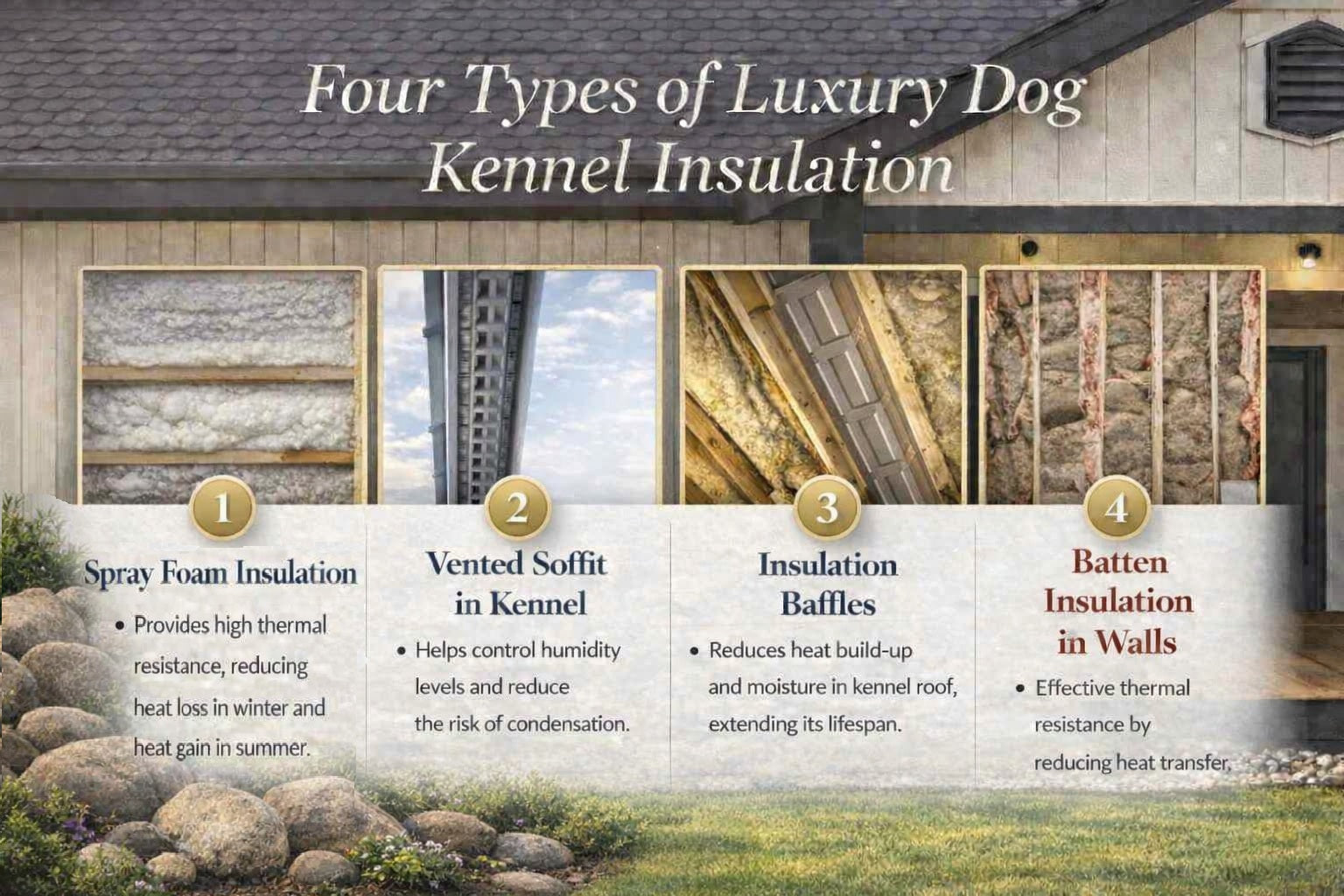
1. R‑13 spray foam insulation
Keyword focus: R‑13 insulated dog kennel, climate controlled dog kennel with spray foam
- What it is: Closed‑cell spray foam applied to building cavities (often floors and sometimes walls).
-
Why it matters:
- Provides high thermal resistance (R‑13), reducing heat loss in winter and heat gain in summer.
- Acts as an air seal, reducing drafts and cold spots.
- Adds structural rigidity to the floor system.
In a true R‑13 insulated dog kennel, you’ll see spray foam called out explicitly—not just “foam” or “insulated floor.”
2. Batten insulation in walls and ceilings
Keyword focus: batten insulated dog kennel walls, residential grade insulated dog house
- What it is: Fiberglass or mineral wool batts installed between studs and rafters.
-
Benefits:
- Effective thermal resistance by reducing heat transfer through the wall and ceiling.
- Sound dampening, which matters in multi‑dog or working‑dog environments.
- Fire‑resistant properties compared to bare wood cavities.
Climate‑controlled models from The Dog Kennel Collection specify R‑13 batten insulation in walls and ceilings—this is the kind of clarity you want to see in any kennel you’re considering.
3. Insulation baffles in the roof
Keyword focus: insulated dog kennel with baffles, roof baffles dog kennel
- What they are: Ventilation channels installed between roof sheathing and insulation.
-
Why they matter:
- Reduce heat build‑up in the roof cavity.
- Help manage moisture and condensation, preventing rot and mold.
- Extend the lifespan of the roof by reducing thermal and moisture stress.
Most preorder doghouses don’t even mention roof ventilation, let alone insulation baffles—that’s a clear line between decorative and engineered.
4. Vented soffits in the kennel
Keyword focus: vented soffit dog kennel, humidity controlled dog kennel
- What they are: Intake vents under the eaves that allow fresh air into the roof or attic space.
-
Benefits:
- Help control humidity levels and reduce condensation risk.
- Improve overall energy efficiency by reducing heat load on the kennel.
A vented soffit dog kennel is designed like a small house, not a sealed box.
5. Insulated floor systems
Keyword focus: insulated dog kennel floor, R‑13 spray foam floor dog kennel
From The Dog Kennel Collection’s commercial‑grade specs, you’ll typically see:
- R‑13 closed‑cell spray foam in the floor
- Pressure‑treated floor joists
- Durable, watertight interior floor (for example, SmartFloor coated with poly‑urea)
- Composite or poly decking in runs for weather resistance
Most preorder doghouses sit on thin plywood or plastic with no stated R‑value. A truly residential grade insulated dog house treats the floor as a critical thermal boundary, not an afterthought.
Climate Control: Heating, Cooling, and Humidity Options
Insulation is only half the story. A climate controlled dog kennel pairs insulation with real HVAC‑style options. Typical options you’ll see on serious, engineered kennels include:
-
Heating options
- LP direct‑vent wall furnaces (for example, 14,000 or 33,000 BTU)
- Wall‑mount electric heaters
-
Cooling options
- 110‑V window A/C units (5,000–15,000 BTU)
- Mini‑split heater/A/C units (for example, 12,000–24,000 BTU)
-
Humidity control
- Commercial dehumidifiers
- Ultrasonic humidifiers with humidistats
When you see a kennel that supports real heaters, A/C units, or mini‑splits, you’re in the realm of climate controlled dog kennels, not novelty shelters.
How Preorder Doghouses Compare (and Where They Fall Short)
1. Insulation claims vs. real specs
If a preorder doghouse:
- Does not list R‑values
- Does not specify spray foam, batten insulation, or insulated floors
- Does not mention vented soffits or insulation baffles
…then it is not comparable to a R‑13 insulated dog kennel built to residential‑style standards.
Even when they say “insulated,” it’s usually:
- Thin foam board or reflective foil
- Limited to one surface (often the roof)
- No continuity, no air sealing, no moisture strategy
You can safely say: preorder doghouses do not have insulation that behaves like residential‑grade assemblies—and if they claim they do, you should ask for the exact R‑values and materials.
2. Comfort and safety over seasons
A climate controlled dog kennel with spray foam and batten insulation:
- Stays warmer in winter with less heater runtime
- Stays cooler in summer with less A/C load
- Manages humidity and condensation, protecting both dogs and structure
A thin‑walled preorder doghouse:
- Tracks outdoor temperature closely
- Can become dangerously hot or cold
- Offers little protection for older dogs, short‑coated breeds, or working dogs recovering from exertion
How to Shop Smart: A Checklist for Residential‑Grade Insulated Dog Houses
Use this checklist when comparing any “luxury” or “insulated” dog house:
-
R‑values listed:
- Walls & ceilings: Look for R‑13 batten insulation or equivalent.
- Floor: Look for R‑13 closed‑cell spray foam or clearly specified insulated floor.
-
Insulation types named:
- Spray foam, batten insulation, insulation baffles—not just “insulated panels.”
-
Ventilation engineering:
- Vented soffit dog kennel design, roof baffles, and clear airflow paths.
-
Floor & interior finishes:
- Moisture‑resistant interior (for example, glassboard) and durable, sealed floors (poly‑urea, SmartFloor, etc.).
-
HVAC compatibility:
- Ability to integrate real heaters, A/C units, or mini‑splits with appropriate electrical requirements.
-
Clear separation from “preorder” sheds:
- If the product page looks like a generic shed listing with a dog door added, it’s not a residential grade insulated dog house.
SEO Corner: Why These Specific Phrases Help You Rank
You’re targeting buyers who care about engineering, not just aesthetics. That’s where long‑tail, low‑competition phrases shine. Examples used in this article include:
- “residential grade insulated dog house” – very specific, high‑intent, and rarely used in mass‑market copy.
- “R‑13 insulated dog kennel” – tied directly to real insulation specs; long‑tail and technical.
- “vented soffit dog kennel” – niche building‑science phrase; likely low competition.
- “insulated dog kennel with baffles” – combines “insulated dog kennel” with “baffles,” which most competitors never mention.
- “climate controlled dog kennel with spray foam” – long, descriptive, and aligned with real product specs.
By weaving these phrases naturally into headings, subheadings, and body copy—as you see here—you position this post to rank for technical, low‑competition queries that serious buyers actually search when they’re past the “cute dog house” phase and ready to invest.
Engineering Accuracy Self‑Check
Before publishing, it’s worth sanity‑checking the technical claims:
- R‑13 spray foam insulation is correctly described as providing high thermal resistance and reducing heat loss/gain, consistent with closed‑cell spray foam behavior.
- Vented soffits and insulation baffles are accurately presented as tools for managing heat and moisture in roof assemblies and extending roof life, which aligns with standard residential construction practice.
- Batten insulation in walls and ceilings is correctly described as providing thermal resistance, some sound control, and fire resistance, consistent with fiberglass or mineral wool properties.
- The contrast with preorder doghouses focuses on common patterns—lack of stated R‑values, unspecified materials, limited coverage—rather than claiming every single product is identical, which keeps the comparison fair.
From an engineering standpoint, this article treats serious kennels as small buildings and applies standard building‑science logic—insulation continuity, ventilation, moisture control, and HVAC compatibility—consistent with how true climate controlled dog kennels are designed.
Check out all of the Executive Estate sizes.
These sizes accommodate one or many dogs and small to very large. Options are available to meet your personal storage needs. View the 40 second tour of the Executive Estate Collection.
- Small Breeds (up to 25 lbs) → 4' × 8', 6' x 8'
- Medium Breeds (25–60 lbs) → 6' × 8' or 6' × 10'
- Large Breeds (60–100 lbs) → 6' x 10', 8' × 10', 8' × 12', or 8' x 14' Double Run
- Giant Breeds (100+ lbs) → 8 x 14 Single Run
- With shed storage space → 8' x 16' includes Separate Feed Room, 8' x 18' includes 8' x 8' Storage Shed, 8' x 20' with 9' x 9.5' Storage Shed
- Lots more Storage Shed and Dog House & Kennel Combo 10' x 24'
Your Your Step‑by‑Step Guide to Designing the Executive Estate of Your Dog’s Dreams awaits.
Any size can be ordered with dividers and additional dog doors to make separate quarters. The doghouse is made to order based on all of your customizations.
Executive Estate Series · Post 7

Written by Mindy Giles