Designer Dog Kennels for Modern Homes: 2026 Guide
Table of Contents
- Why Designer Dog Kennels Transform Your Home
- Modern Indoor Dog House Styles That Elevate Your Space
- Dog Kennel Furniture: Choosing Between Contemporary and Artisanal Designs
- Indoor Dog Kennel Ideas for Every Home Aesthetic
- Sizing Your Kennel: The Foundation of Comfort and Safety
- Custom Dog Kennel Solutions for Your Specific Needs
- Materials, Durability, and Long-Term Value
- Conclusion: Investing in Your Dog's Sanctuary
- Frequently Asked Questions
Last Updated: October 18, 2026
Why Designer Dog Kennels Transform Your Home
A well-designed dog kennel does more than provide shelter, it becomes part of your home's visual story, replacing the utilitarian wire cage with pieces that reflect your design sensibility.

Designer dog kennels serve a dual purpose: a secure sanctuary for your pet and genuine furniture for you. A den-like retreat reduces anxiety, peace of mind for you, security for your dog.
Modern Indoor Dog House Styles That Elevate Your Space
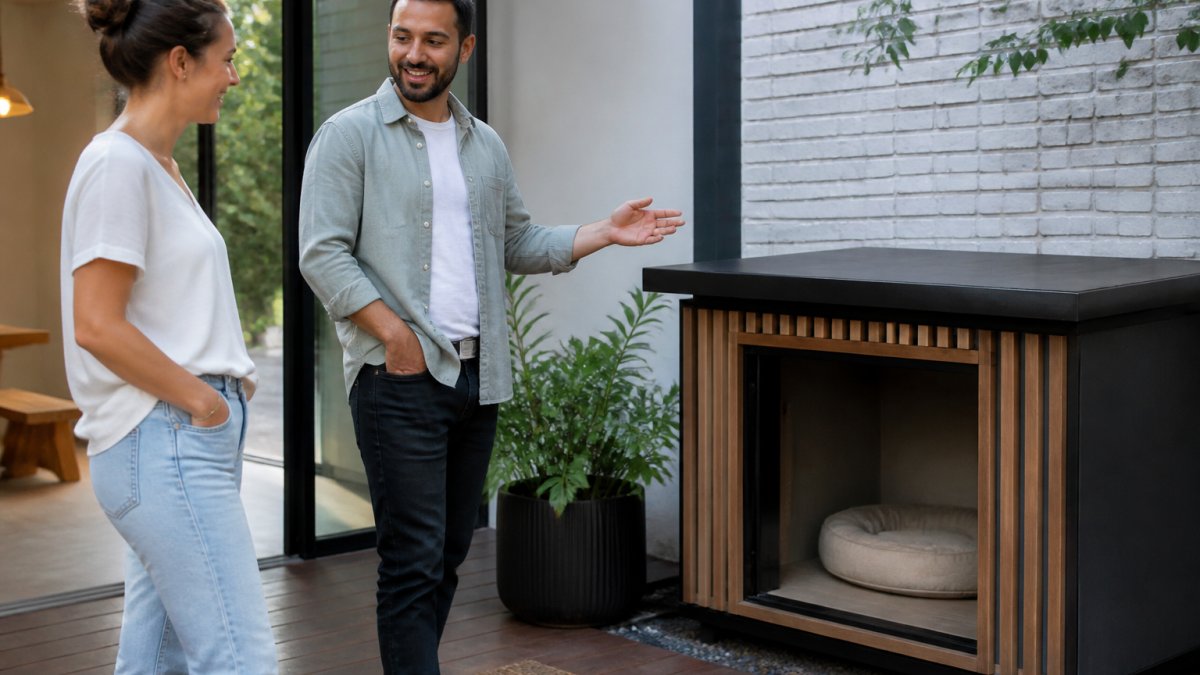
Contemporary design emphasizes clean lines, neutral palettes, and functional beauty. A modern indoor dog house strips away ornamentation, focusing on proportion, material quality, and interaction with surrounding furniture.
The Moderno Contemporary Luxury Dog Crate exemplifies this approach. Its brushed stainless-steel hardware and furniture-grade finish transform what could be a bulky cage into an architectural statement.

Modern indoor dog houses typically feature:
- Neutral color palettes (grays, whites, natural wood tones)
- Minimal visible hardware or hardware finished in stainless steel
- Clean geometric forms without decorative cutouts
Dog Kennel Furniture: Choosing Between Contemporary and Artisanal Designs
Contemporary designs communicate restraint; artisanal pieces tell a story of craftsmanship.
Furniture-Style Crates for Compact Living
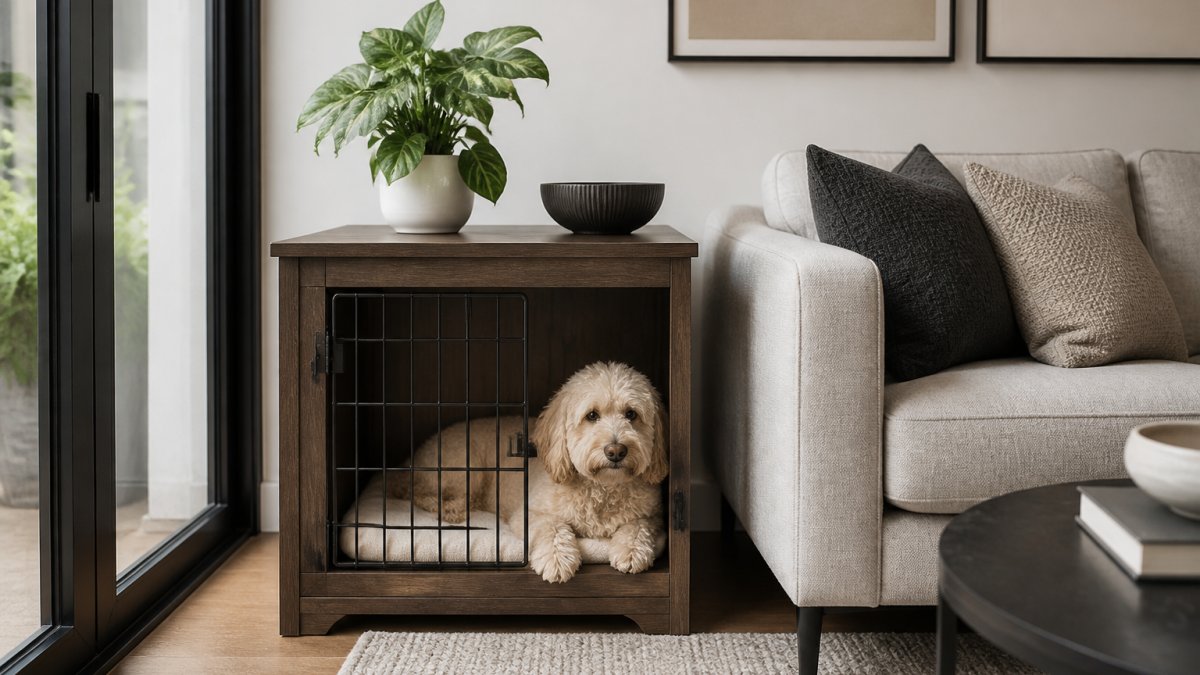
Furniture-style crates solve a genuine problem for anyone with limited square footage: same footprint as a traditional kennel, but they work as side tables, end tables, or nightstands.
The Fresco Luxury Side Table Crate demonstrates this dual-function approach: its Lunar grey finish and contemporary proportions let you place a lamp, stack books, or set a drink on top without it feeling like a pet accessory.

Space-saving design doesn't compromise comfort: the Fresco includes 360-degree ventilation and anti-anxiety features, with open-mesh panels that let your dog see their surroundings while maintaining a secure, den-like environment.
Furniture-style crates work best in homes where:
- Square footage is limited
- Your dog's crate will be in a primary living space
- You want the kennel to serve double duty
Wooden Kennels as Statement Pieces
Wooden kennels occupy a different design territory: rather than blending in, they command attention as crafted objects.
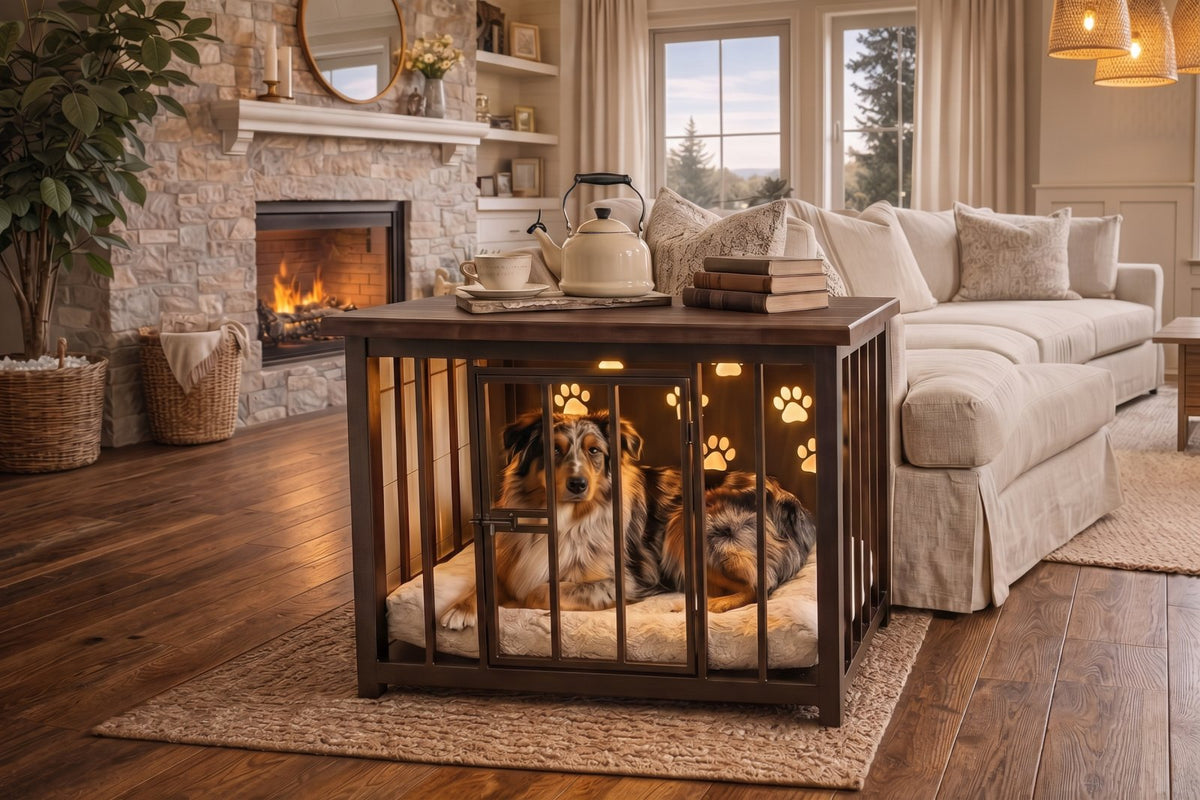
The Artisanal Luxury Wooden Dog Kennel & End Table represents the highest expression of this approach. Hand-built in Colorado by a family-owned workshop, each piece is meticulously finished to heirloom standards. The warm wood tones, sculptural steel bars, and decorative paw-print cutouts create visual interest that a sleek contemporary crate cannot match.
Wooden kennels excel in homes with:
- Rustic, transitional, or eclectic design aesthetics
- Spaces where a statement piece enhances rather than clutters
- Owners who value handcrafted quality and visible artistry
Indoor Dog Kennel Ideas for Every Home Aesthetic
Your home's aesthetic determines which kennel style feels right; the wrong choice, however beautiful in isolation, will feel jarring.
Minimalist homes call for simplified kennels with minimal visual noise.
Transitional spaces benefit from furniture-style crates that bridge traditional and modern elements, a contemporary crate in a neutral finish works alongside traditional furniture and earns its place through dual functionality.
Rustic or farmhouse aesthetics pair beautifully with wooden kennels; a handcrafted piece with visible joinery and warm wood tones reinforces the design narrative.
The key principle: your kennel should feel like it belongs, not like a compromise.
Sizing Your Kennel: The Foundation of Comfort and Safety
Proper sizing is the single most important decision you will make, and where most buyers go wrong. An undersized kennel creates anxiety; an oversized one undermines den-like security. The goal: a kennel your dog can stand in without crouching, turn around in without touching the sides, and lie down in fully stretched out, and no larger.
How to Measure Your Dog
Measure your dog while standing naturally on a flat floor, not sitting or lying down. Use a soft tape measure and record three numbers:
- Body length: from the tip of the nose to the base of the tail (not the tip of the tail).
- Height: from the floor to the top of the head, with the head held in a normal standing position, not stretched up or tucked down.
- Width: across the widest part of the chest, just behind the front legs.
Then apply these interior-dimension rules of thumb:
- Interior length: body length plus 4 to 6 inches. This allows your dog to turn around and lie down without pressing against the door.
- Interior height: standing height plus 2 to 3 inches. Your dog should be able to stand erect with clearance above the head.
- Interior width: chest width plus 2 to 3 inches on each side, so your dog can turn without scraping.
Measure twice: a dog measured while excited will often stand taller or longer than one measured calmly, so repeat on a different day if you can.
Interior vs. Exterior Dimensions
Designer kennels are furniture, and furniture dimensions are usually quoted as exterior measurements. A crate listed as 36 inches long may have only 32 to 33 inches of interior length once you account for frame thickness, door depth, and panel construction.
This matters most for furniture-style crates, where a thick top, side panels, and a recessed door eat into usable space.
Balancing Kennel Size Against Floor Space
A correctly sized kennel is not the largest one that fits your room, it is the smallest one that fits your dog comfortably. Oversizing is a common mistake: a dog that can pace, eliminate in one corner, and sleep in another will often do exactly that.
Plan your floor space before you shop:
- Measure the wall or floor area where the kennel will sit, including clearance for the door to swing open fully.
- Add at least 2 to 3 inches of breathing room on each side so the kennel does not look wedged into place.
- Confirm the kennel's exterior footprint, not just its interior dimensions, against that space.
Size Categories as a Starting Point
Weight-based categories are a rough filter, not a substitute for measurement, two dogs of the same weight can have very different body lengths.
Moderno Contemporary Luxury Dog Crate →
- Small (up to 25 lbs): roughly 24 to 30 inch interior length
- Medium (25 to 60 lbs): roughly 30 to 42 inch interior length
- Large (60 to 100 lbs): roughly 42 to 48 inch interior length
Use these ranges to narrow your search, then confirm against your dog's actual measurements. For puppies, size for adult dimensions and use a divider panel if the kennel offers one, buying a puppy-sized kennel and replacing it in a year is the most common sizing mistake we see.
Common Sizing Mistakes
- Choosing based on your dog's current size without accounting for growth.
- Selecting a kennel that is "close enough" rather than measuring precisely.
- Assuming a kennel labeled for your dog's breed is the right fit.
Measure your specific dog, confirm interior dimensions with the seller, and check the exterior footprint against your floor plan. That three-step process prevents nearly every sizing problem.
Custom Dog Kennel Solutions for Your Specific Needs
Off-the-shelf kennels work for many situations, but custom-built options let you specify dimensions, materials, finishes, and design details. A Custom Built Dog House solves real problems: unusual room dimensions, or unavailable materials and finishes.
The Artisanal Luxury Wooden Dog Kennel & End Table is fully customizable, cutout designs, and dimensions. The process begins with a consultation: our team helps you envision the final piece and provides a quote before you commit.
Custom solutions make sense when:
- Standard sizes don't fit your space or your dog
- Your design aesthetic requires specific materials or finishes
- You want a piece that's genuinely unique
Materials, Durability, and Long-Term Value
Material quality determines whether your kennel stays beautiful for years or deteriorates within months. Designer kennels justify their premium pricing only if you understand what each material does well and where it fails.
Wood and Wood-Grain Finishes
Strengths: warm appearance, repairable surfaces, heirloom potential, and a look that anchors a room.
Weaknesses: wood is hygroscopic, it absorbs and releases moisture, so it can swell, warp, or crack in humid rooms or near a dog that drools or has accidents.
Best for: dry, climate-controlled rooms; dogs that are reliably house-trained; owners willing to wipe surfaces promptly and keep bedding clean.
Engineered Panels
Engineered panels, MDF, plywood, and similar composites, are common in furniture-style crates because they hold a crisp, flat finish and are dimensionally stable.
Strengths: stable, uniform, and often more affordable than solid hardwood; takes paint and laminate finishes cleanly.
Best for: living spaces with stable humidity; dogs that are not heavy chewers; buyers who want a clean modern look at a lower price point.
Metal and Stainless-Steel Hardware
Metal construction and stainless-steel hardware are the workhorses of the category.
Strengths: excellent moisture resistance, easy cleaning, no odor retention on non-porous surfaces, and long service life.
Weaknesses: bare metal can be noisy, and some dogs find a fully open metal crate less den-like.
Best for: puppies and adolescent dogs, dogs prone to accidents, homes in humid climates, and anyone who prioritizes easy cleaning.
Moisture, Odor, and Cleaning
Moisture is the enemy of every kennel material except stainless steel. A few practical rules:
- Wipe up accidents immediately, and use an enzyme-based cleaner rather than ammonia-based products, which can encourage repeat marking.
- Keep bedding washable and wash it weekly; odor usually lives in the bedding, not the frame.
- Avoid placing a wood or engineered-panel kennel directly against an exterior wall in a humid room, where condensation can wick into the back panel.
Chew Resistance and Wear
No furniture-grade kennel is chew-proof, and any listing that claims otherwise should be treated with skepticism. Chew resistance comes from sturdy construction, recessed hardware, and secure latches, not from a single material. Puppies and anxious dogs will test every kennel, so plan for the first year to be the hardest on the finish.
A Realistic Value Calculation
A quality designer kennel represents a 5 to 10 year investment, not a temporary solution. The value calculation is not simply price divided by years, it is price divided by years of usable life, and a kennel that swells, smells, or loses its finish stops being usable long before it falls apart.
- Stainless-steel hardware outlasts plated or painted alternatives by years.
- Solid hardwood withstands daily use better than veneered or laminated alternatives.
- Furniture-grade finishes resist staining and scratching compared to budget finishes.
Ask any seller for the specific material of the frame, the door, and the hardware, and for care instructions in writing. A seller who cannot answer those questions is telling you something about the product.
Conclusion: Investing in Your Dog's Sanctuary
Your dog deserves a space that's both physically comfortable and psychologically secure. A well-chosen designer dog kennel provides both while elevating your home's aesthetic rather than detracting from it.
At Dogominium, we understand this balance. Our designer dog kennels combine architecturally inspired design with genuine craftsmanship.
Your dog's comfort and your home's beauty don't have to be competing priorities.
Frequently Asked Questions
How do I choose the right size designer dog kennel?
Measure your dog from nose to tail base and add 4-6 inches for comfort. Your dog should stand, turn around, and lie down fully extended inside. For growing puppies, choose a size that accommodates their adult weight. Interior dimensions matter more than exterior footprint, check product specifications carefully. A properly sized kennel reduces anxiety and supports crate training, making it a critical safety and comfort factor.
What makes a designer dog kennel different from a standard crate?
Designer dog kennels prioritize aesthetics alongside functionality. They feature furniture-grade finishes, premium materials like hardwood and stainless steel, and architectural lines that complement modern interiors rather than dominate them. Products like the Moderno Contemporary Luxury Dog Crate ($449.99) and the Artisanal Luxury Wooden Dog Kennel ($2,789.99) are engineered to serve as functional furniture pieces, end tables, side tables, or accent pieces, while providing secure, comfortable spaces for your dog.
Can a dog kennel actually double as furniture in my home?
Yes. Modern designer kennels are specifically built as dual-purpose pieces. Furniture-style crates feature flat, sturdy tops that safely support lamps, books, or decorative items. Wooden kennels with end-table designs integrate into bedrooms and living rooms without standing out. The key is choosing a model with adequate weight capacity and a finish that matches your décor. Verify dimensions and load ratings before placing items on top.
What materials hold up best for indoor dog kennels in different climates?
For indoor use, stainless steel hardware resists rust and corrosion regardless of humidity. Furniture-grade wood and engineered panels withstand temperature fluctuations. Hand-wipe care with mild soap and water preserves finishes.